


Peptides are short chains of amino acids, the same building blocks that make up proteins, and Canadian laboratories are studying them within a research system built on collaboration, training, and investigator-led discovery. If you’re a patient, a family member, or a clinician wondering where this work is heading, the clearest signals come from how that research is funded and organized. Many labs rely on peptides for research, shipped in Canada which keeps projects moving without long delays.
The Canadian Institutes of Health Research has named funding health research and training, investigator-initiated studies, and cross-sector collaborations among its 2026-27 priorities. It also plans to strengthen life sciences capacity alongside NSERC, whose Alliance grants pair university researchers with partner organizations and international teams. Programs like the Canada Excellence Research Chairs add further momentum.
What we can’t yet tell you is which specific peptide projects or applications are underway, and we won’t guess. Funding priorities show direction, not results. Still, they point toward a future where discoveries can reach people faster. That matters to us, because the best rehabilitation care is personalized and interdisciplinary, and it grows stronger when new knowledge reaches patients and their care teams.
Peptides in Plain Language: What They Are and Why Researchers Care

Think of your body as a busy city where messages need to travel quickly and accurately. Peptides are among the messengers. They are short chains of amino acids, the same building blocks that make up proteins, but much smaller. If a protein is a long, detailed instruction manual, a peptide is more like a brief note passed between neighbours.
Our bodies make many peptides naturally. Some help cells “talk” to one another, and some act as signals that tell tissues how to respond. That is a big part of why scientists find them so interesting. By studying how these signalling molecules work, researchers hope to better understand how the body maintains itself, responds to stress, and recovers.
It helps to be clear about what that curiosity means. Studying how peptides behave in a laboratory is about learning, not about promising a result. Understanding a natural process is a first step, and it can take many years before anything learned in a lab ever informs how care is delivered. Researchers ask careful questions, test them, share findings, and build on each other’s work.
For patients and families, this can be an encouraging thing to know. Science is steadily improving our picture of how the body heals, and that kind of knowledge can shape health care over time. It also reminds us why asking questions and staying informed are worthwhile, as long as we keep expectations realistic and rely on guidance from a trusted care team.
In the sections ahead, we’ll look at how Canadian research is supported and organized, so you can see the bigger picture of where this kind of work comes from.
How Canadian Peptide Research Is Supported
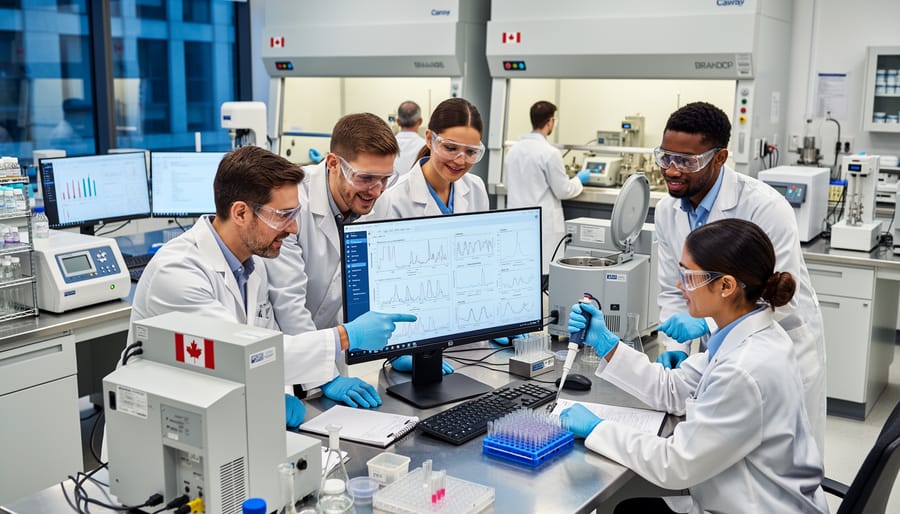
CIHR’s 2026-27 Priorities
Each year, the Canadian Institutes of Health Research lays out where it plans to direct its energy and funding. According to the CIHR 2026-27 Departmental Plan three priorities stand out: funding health research and training, investing in investigator-initiated research, and funding leading-edge collaborations across every sector of the health ecosystem.
Investigator-initiated research simply means projects driven by a researcher’s own questions rather than a topic handed down from above. That freedom matters for a field like peptide science, where curiosity often leads to unexpected places. CIHR is also working to strengthen Canada’s health and life sciences research capacity in partnership with NSERC, the Natural Sciences and Engineering Research Council of Canada.
Here is a quick look at how these programs fit together:
| Program | Who supports it | What it funds |
|---|---|---|
| Health research and training | CIHR | Research projects and the people who carry them out |
| Investigator-initiated research | CIHR | Projects shaped by a researcher’s own questions |
| Leading-edge collaborations | CIHR | Partnerships across all sectors of the health ecosystem |
| Life sciences capacity building | CIHR with NSERC | Stronger health and life sciences research capacity |
For patients and families, the takeaway is reassuring. Canada is investing in both the science and the scientists, and it expects them to work together.
NSERC’s Role and Collaboration Grants
The Natural Sciences and Engineering Research Council of Canada (NSERC) will continue to support natural sciences and engineering research in 2026-27, helping to strengthen the country’s research foundation. That matters for peptide science, which sits at the meeting point of chemistry, biology, and engineering.
Two NSERC programs show how this support is built around teamwork. Under the Alliance Advantage and Alliance International streams, Alliance Advantage grants fund research projects carried out alongside partner organizations. The goal is to address those partners’ needs and speed up how quickly results are put to practical use. Think of it as a researcher and a partner organization working at the same table, rather than a lab working alone and handing off findings later.
The Alliance International Collaboration grants take a similar spirit across borders. They support joint projects between Canadian university researchers and their international counterparts. These projects must show strong benefits for Canada, and they must offer valuable training opportunities for Canadian students and postdoctoral fellows.
Taken together, these programs reward partnership, shared learning, and real-world relevance. They also invest in people, helping the next generation of scientists build skills and connections. This is a funding picture, not a list of specific projects, and it describes the conditions laboratories work within rather than any particular discovery.
Canada Excellence Research Chairs and Related Programs
Canadian universities also draw on a national program built to attract and keep top research talent. The CERC tri-agency program is a transfer payment program that brings together three related initiatives: the Canada Excellence Research Chairs, the Canada Impact+ Research Chairs, and the Canada Impact+ Emerging Leaders initiatives.
Think of it as support at different stages of a research career. Together, these initiatives help Canadian universities build on the country’s reputation as a global leader in research and innovation. For a laboratory, that kind of backing can mean the stability to pursue long-term questions and the ability to bring strong scientific minds into a research community.
It’s worth being clear about what this does and doesn’t tell us. These programs describe the structure that supports research, not the specific topics any one laboratory is studying. Nothing here confirms a particular peptide project or result. What it does show is a national commitment to strengthening the people and places where health science happens, which is the foundation any future discovery, peptide-related or otherwise, would grow from.
What These Trends Signal for Laboratories
Looking at CIHR and NSERC’s 2026-27 priorities together, a few patterns stand out. What follows is our interpretation, not a report on any specific lab’s work.
Collaboration across sectors. CIHR plans to fund leading-edge collaborations across all sectors of the health ecosystem, and NSERC’s Alliance Advantage grants pair researchers with partner organizations. That suggests laboratories are expected to work alongside others rather than in isolation, which echoes how we approach care at Mackay Therapy and Rehabilitation.
Training the next generation. NSERC’s Alliance International Collaboration grants require valuable training opportunities for Canadian students and postdoctoral fellows. Building skilled researchers is clearly treated as part of the mission, not an afterthought.
International partnerships with local benefit. Those same grants support joint projects between Canadian and international university researchers, but projects must show strong benefits for Canada. Global knowledge-sharing is encouraged, with a clear eye on domestic impact.
A focus on practical use. Alliance Advantage grants aim to accelerate the application of results. Getting findings out of the lab and into real-world settings is a stated goal. Areas such as tissue repair research show how early-stage work can be tested step by step before it ever reaches a care setting.
It’s important to be clear about the limits here. This article does not cover specific active research areas, recent publications, or clinical or industry applications of peptides, and we won’t guess at them. For current project details, the best sources are CIHR and NSERC directly.
Funding priorities tell us how research is organized and what it values. They don’t tell us what any lab has found, and that distinction helps keep curiosity healthy and expectations realistic.
Why Research News Matters to Patients and Families

When a headline mentions a promising new area of science, it’s natural to feel a spark of hope. If you or someone you love is recovering from an injury, a stroke, or a long-term condition, you may wonder whether the next breakthrough could change things. That hope is understandable, and it deserves a thoughtful response.
The best way to approach emerging science is with curiosity and a few good questions. Ask what stage the research is at. Ask whether it has been tested in people or only in a laboratory. Ask how it applies to your own situation. Then bring those questions to your care team before making any decisions about your health.
It helps to remember how research moves. The funding priorities across Canada emphasize collaboration, training, and getting results into practical use, but that work unfolds over years. Laboratory findings are an early step, not an approved treatment. Meanwhile, recovery happens in the present, and the foundation of it is proven, personalized rehabilitation.
Consider a composite scenario. A man in his fifties is recovering after a stroke and struggles with walking and daily tasks. Progress doesn’t arrive in one dramatic leap. It builds through steady, individualized work: a short walk that gets a little longer each week, a kitchen task practiced until it feels natural, a goal adjusted when it’s time to aim higher. Each small gain is guided by professionals who know his goals. A physiatrist for recovery can help coordinate that plan, while our healthcare team works together so nothing is left to chance.
Staying informed is a good thing. It simply works best alongside people who can help you turn information into a plan that fits your life.
Common Questions About Peptide Research
Questions often come up when new science makes the news, so here are clear answers to a few of the most common ones.
What are peptides?
Peptides are short chains of amino acids, the same building blocks that make up proteins. Researchers study them because many of the body’s own signalling molecules work in this way.
Is laboratory research the same as an approved treatment?
No. Laboratory research asks questions and tests ideas, and it takes time to move toward clinical care. Being studied in a lab does not mean something is a proven or approved option for patients.
Who funds health research in Canada?
National agencies play a central role. The Canadian Institutes of Health Research funds health research and training, while NSERC supports natural sciences and engineering research, and the tri-agency Canada Excellence Research Chairs program helps universities attract research leaders.
How can I tell whether new research applies to my situation?
Start by asking your care team. They know your history and goals, and they can help you judge whether a finding is relevant, early-stage, or simply not a fit for you right now.
If a headline leaves you with more questions than answers, that’s completely normal. Bring those questions to your next appointment so you can talk them through together, and keep your recovery grounded in the personalized care that is helping you today.
Canadian health research is moving in a clear direction. National priorities emphasize collaboration across sectors, training the next generation of researchers, and getting results into practical use. Peptide science is one small part of that picture, and while it’s worth following with curiosity, progress in the lab takes time to reach the clinic.
What helps you recover today is steady, individualized work. At Mackay Therapy and Rehabilitation, physiotherapists, occupational therapists, speech-language pathologists, and other professionals work together around your goals, so your care plan reflects your life, not a generic template. Whether you’re rebuilding strength, regaining independence at home, or finding your voice again, you have a team in your corner. If you’re curious about convenient options, you can learn how e-rehab works alongside in-person support.
We’ll keep following the research landscape and share what’s meaningful, always grounded in what works now. If you or someone you love is ready to take the next step, reach out to our team. Tell us what matters most to you, and we’ll build the plan together, one encouraging step at a time.