


Cognitive behavioral therapy (CBT) is a structured, skills-based form of talk therapy that helps you understand how your thoughts, feelings, and behaviors feed anxiety, and then gives you practical tools to change those patterns. It’s also a first-line treatment for anxiety disorders, which means it’s among the first options clinicians recommend, not a last resort.
Anxiety can make everything feel urgent and unmanageable, whether it’s you living with it or someone you love. CBT offers something steady to hold onto. Sessions focus on spotting the worried thoughts that spiral, testing whether they hold up, and gradually facing the situations that anxiety tells you to avoid. Structured CBT usually takes multiple sessions, so progress builds step by step. It can be delivered face to face by an experienced clinician or in guided online formats, and tools like MindShift CBT, MoodGym, and E-couch put CBT-based skills within reach. It’s also worth considering for children and teens aged 6 to 18 with social, generalized, or separation anxiety.
At Mackay Therapy and Rehabilitation, we believe care works best when it’s personalized and when your whole team works together. Below, we’ll explain what CBT involves, who it helps, what sessions look like, and how to get started.
What CBT Therapy Actually Is (In Plain Language)
Cognitive behavioural therapy, or CBT, rests on a simple idea: what we think, how we feel, what our bodies do, and how we act are all connected. When anxiety shows up, these pieces tend to feed one another. A worried thought triggers a racing heart, the racing heart feels like proof that something is wrong, and so we avoid the situation, which keeps the fear alive.
CBT helps you spot that loop and gently interrupt it. Rather than digging endlessly through the past, it focuses on what’s happening now and the practical skills that can change it. Sessions are collaborative. You and your clinician set goals together, try strategies, and adjust the plan based on what works for you.
A few terms come up often, so here they are in everyday language:
- Cognitive restructuring
- Learning to notice an anxious thought, test whether it’s accurate, and replace it with a more balanced one.
- Behavioural activation
- Scheduling meaningful or enjoyable activities on purpose, so your mood and motivation aren’t left to chance.
- Exposure
- Facing a feared situation in small, manageable steps so the fear gradually loses its grip.
- Thought record
- A simple worksheet where you jot down a situation, the thought and feeling it triggered, and a more helpful way to see it.
- Avoidance
- Steering clear of something that makes you anxious, which brings short-term relief but often strengthens the fear over time.
None of these skills require you to be an expert. You build them step by step, with support, and practice between sessions so they become second nature in daily life.
Why CBT Therapy Is a First-Line Choice for Anxiety

If you’ve been wondering whether CBT is worth trying, here’s something reassuring: it isn’t a fringe idea or a passing trend. Psychotherapy is first-line treatment for anxiety disorders, and cognitive behavioural therapy sits right at the centre of that recommendation. In plain terms, when professionals look at how best to help people with anxiety, talking therapy that teaches practical skills comes first.
That matters because it tells you the path you’re considering is a well-trodden one. CBT is recognized as a first-line treatment for the kinds of anxiety problems that disrupt sleep, work, school and relationships. You aren’t gambling on something experimental. You’re choosing an approach that clinicians widely turn to first.
There’s also a broader principle behind this. CBT services should be universally available and accessible for all, which reflects a shared belief that nobody should have to struggle alone with anxiety. Help can look different depending on your needs. It might be face-to-face with an experienced clinician or guided in another format, and we’ll walk through those options later in this article.
If anxiety has made you feel stuck, let this be a reason for hope. Effective, evidence-informed support exists, and reaching for it is a practical, courageous step. At Mackay Therapy and Rehabilitation, we see CBT as one valuable piece of personalized care, shaped around you rather than a one-size-fits-all plan.
Types of Anxiety CBT Can Support
Social and Generalized Anxiety
Social anxiety often shows up as dread before a meeting, a party, or even a quick phone call. Generalized anxiety feels different: a steady stream of “what if” worries that won’t switch off. CBT treats both by helping you see how your thoughts, your body’s reactions, and your behaviour feed one another, since anxiety affects the mind and body together.
For social fears, you learn to test your predictions (such as “everyone will notice I’m nervous”) and take small, manageable steps back toward situations you’ve been avoiding. For persistent worry, you practise spotting worry loops, questioning them, and setting them down. Research supports CBT for social and generalized anxiety and it’s a practical, skills-based place to start.
Anxiety in Children and Teens
Anxiety doesn’t wait until adulthood. Children and teens can struggle with social worries, constant “what if” thinking, or distress when apart from the people they rely on. The good news is that CBT for ages 6 to 18 is recommended as one of the treatments to consider for social, generalized, and separation anxiety.
For young people, CBT is practical and often feels more like skill-building than “therapy.” Sessions are structured, and a child learns to spot worried thoughts, test them out, and face fears in small, manageable steps.
Families can play a real part. Parents and caregivers can learn the same skills, encourage practice between sessions, and celebrate small wins without rushing progress. A personalized plan matters here, since a seven-year-old and a sixteen-year-old need very different approaches, and our interdisciplinary team keeps the whole child, and the whole family, in view.
What to Expect From CBT Sessions
If you’re picturing a lecture or an endless retelling of your past, CBT is quite different. Sessions are structured and collaborative, so you always know what you’re working on and why.
Early on, you and your clinician talk through what’s been happening: the worries, the situations you’ve started avoiding, the physical sensations that show up. From there, you set goals together. Maybe you want to feel calmer in meetings, sleep without racing thoughts, or say yes to invitations again. Those goals guide everything that follows.
Most sessions follow a familiar rhythm. You check in on how the week went, focus on one skill or pattern, and practice it right there with support. You might learn to spot a thought that sends your anxiety spiking, test whether it holds up, or take a small, manageable step toward something you’ve been avoiding.
The real progress often happens between sessions. You’ll usually be invited to try what you’ve learned in everyday life, then bring back what worked and what didn’t. That isn’t homework to pass or fail. It’s how new habits take hold, and it helps you feel more like the one in control.
It helps to know that structured CBT typically takes multiple sessions rather than a one-time fix. Everyone’s pace is different, so a good plan is adjusted as you go instead of following a rigid script. Some people also pair in-person care with online support to keep practicing skills between appointments.
At Mackay Therapy and Rehabilitation, personalized care means your plan reflects your life, your goals, and your comfort level. You’re a partner in the process from the very first conversation, and you never have to rush it.
Ways to Access CBT: In Person, Guided, and Online
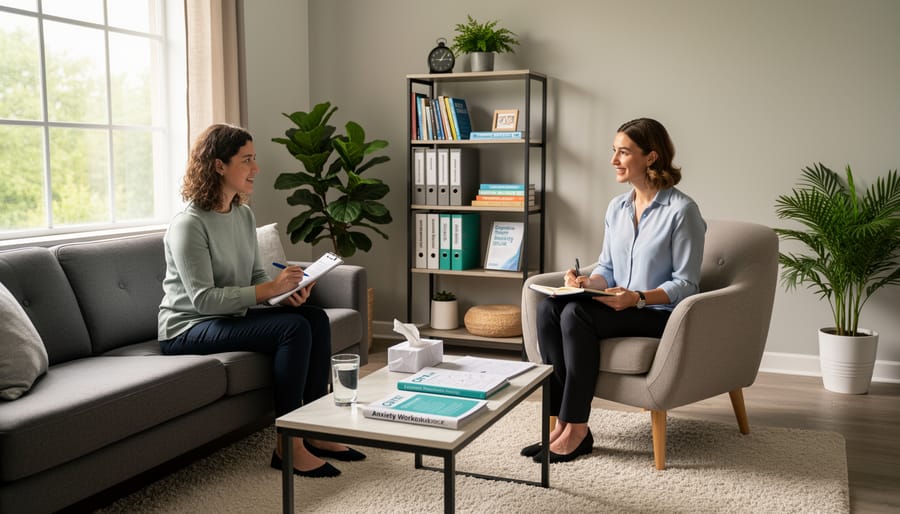
There isn’t just one door into CBT, and that’s good news. Different routes suit different needs, schedules, and comfort levels, so you can pick the one that fits where you are right now.
CBT can be delivered face-to-face by an experienced clinician, or as guided support where someone helps you move through the material. Many people also begin with self-help online programs they can work through at their own pace. Some people start online and later add in-person sessions, or the other way around. There’s no single right path.
| Option | How it is delivered | Who it may suit |
|---|---|---|
| Face-to-face CBT | Sessions with an experienced clinician | People who want personal feedback and a plan built around their own situation |
| Guided CBT | CBT material supported by a guide along the way | People who like structure but want some human support |
| MindShift CBT | Self-help tool from Anxiety Canada | People looking for practical, CBT-based strategies for coping with anxiety |
| E-couch | Online CBT program | People dealing with social anxiety disorder, generalized anxiety disorder, or depression |
| MoodGym | CBT-based self-help tool | People wanting to learn skills to manage anxiety and depression |
Each of the online tools has its own focus. MindShift CBT was developed by Anxiety Canada and offers CBT-based strategies for coping with anxiety. E-couch is online CBT for social anxiety disorder, generalized anxiety disorder, and depression. MoodGym is a self-help tool for learning skills to manage anxiety and depression. You can find more about MindShift CBT and E-couch through CAMH’s anxiety resources.
Because programs change over time, it’s worth checking the details yourself, including what each one offers and whether it’s available to you, before you commit.
Online programs can be a helpful starting point, but they work best when they fit your life. If you’d like someone to help you choose, a personalized approach can help match the right type of support to your goals. At Mackay Therapy and Rehabilitation, our healthcare team works together so that mental and physical wellbeing are considered side by side.
How an Interdisciplinary, Personalized Approach Strengthens CBT
Anxiety rarely stays in one place. It can disrupt sleep, tighten muscles, and drain energy, and then shape how people communicate, manage routines, and take part in everyday life. That is why CBT often works best when it isn’t treated in isolation. At Mackay Therapy and Rehabilitation, our interdisciplinary approach looks at the whole person, so the skills learned in CBT can be supported by care that addresses the physical and practical sides of daily living too.
An interdisciplinary team can coordinate around a personalized plan. Instead of asking you to fit a standard program, we start with what anxiety is getting in the way of for you, whether that’s getting out of the house, speaking up at work, or simply getting through the evening without dread. Each part of your care is then shaped around those goals, so the work you do in sessions carries over into real life.
Consider a composite example. A woman begins CBT because worry keeps her up at night and she’s started avoiding phone calls and errands. As she learns to spot anxious thoughts and test them gently, her care team also supports her sleep routine and helps her rebuild a manageable daily schedule. She starts with one short phone call, then a trip to the shop. Over time those small steps add up to something bigger: more confidence, steadier days, and a sense that her life is opening up again.
That is the heart of a patient-centered approach. CBT provides the skills, and coordinated, personalized support helps you put them to work.
Common Questions About CBT Therapy for Anxiety
Starting therapy can feel like a big step, so it helps to have clear answers to the questions people ask most. Here are a few of the common ones, answered as plainly as we can.
Is CBT only for severe anxiety?
No. Psychotherapy is a first-line treatment for anxiety disorders, and CBT is one of the most widely recommended approaches, so it can be a good fit whether your worry feels occasional or constant. A professional assessment can help you decide what level of support makes sense.
How many sessions will I need?
Structured CBT involves multiple sessions rather than a single visit, and the number varies from person to person. Your clinician will talk with you about a plan that fits your goals and adjust it as you go.
Should I choose online or in-person CBT?
Both are options. CBT can be delivered face-to-face by an experienced clinician or in a guided format, and online programs like MindShift CBT, E-couch and MoodGym offer self-help tools. Many people find the right choice depends on how much personal guidance they want.
Can my family be involved?
For children and teens aged 6 to 18 with social, generalized or separation anxiety, CBT should be considered among the treatments offered, and families often play a supportive role. Adults can also invite a trusted person to help them practice new skills at home.
You may also wonder whether CBT replaces other support. It doesn’t have to. Many people use it alongside other care, and that’s where a team approach really helps. At Mackay Therapy and Rehabilitation, personalized care means looking at your whole picture, including how anxiety touches sleep, routines and daily activities, so your plan works together rather than in pieces.
If you’re ready to begin, the simplest first step is a conversation. Share what you’ve been experiencing, what you’d like to change, and any questions you have. There’s no need to have it all figured out beforehand.
Living with anxiety can feel like carrying a weight you were never meant to carry alone. The good news is that you don’t have to. Psychotherapy is the first-line treatment for anxiety disorders, and CBT is widely recommended precisely because it gives people practical skills they can use in everyday life.
Just as encouraging, there are many ways in. You can work face-to-face with an experienced clinician, try guided support, or explore self-help tools like MindShift CBT, E-couch, or MoodGym. The right route is the one that fits your life, and it’s fine if that takes some thought.
Reaching out is never a sign of weakness. It takes real strength to say, “I want things to feel different.” If you or someone you love is ready to explore what support could look like, we’d welcome a conversation. The team at Mackay Therapy and Rehabilitation can help you build a personalized plan, one that supports your whole wellbeing and moves at a pace that feels right for you.